The history of the Berber rug is the history of North Africa itself. While often viewed through the lens of modern interior design, these textiles represent an unbroken 1,000-year-old lineage of the Amazigh (Berber) people. From the first recorded tribal looms in 622 AD to the living rooms of Frank Lloyd Wright and Le Corbusier, the Berber rug has survived centuries of dynastic shifts and colonial influence to remain a global icon of ‘material honesty’ (UNESCO Intangible Heritage Review, 2024).
To understand a Moroccan Berber rug, one must look beyond the wool. These are not merely decorative items; they are historical documents, woven by women who served as the primary keepers of tribal memory.
1. Pre-Islamic Origins: The Animist Loom
Before the arrival of Islam in the 7th century, the Amazigh tribes practiced animist religions that centered on the natural world and spiritual protection. This is where the core vocabulary of Berber rug symbols began.
- The Loom as a Sacred Space: The vertical loom was often treated with ritualistic respect. It was believed that the rug “grew” like a living being, with the bottom fringe representing the roots and the top representing the soul.
- Tifinagh Symbols: Many early rugs featured the Tifinagh alphabet and symbols for the “evil eye,” fertility (the diamond), and protection (the hand or “Khamsa”).
2. The Golden Age of Trade (12th – 16th Century)
As the great Moroccan dynasties (Almoravids and Almohads) expanded their reach into Al-Andalus (Spain) and Sub-Saharan Africa, the Berber rug became a valuable trade commodity.
- Introduction of Dyes: Trade with the East brought indigo from India, saffron from the Taliouine region, and cochineal from the Mediterranean. These natural dyes allowed weavers to move beyond the natural ivory/black palette into the vibrant reds and blues seen in Vintage Boujaad and Azilal pieces.
- Urban vs. Rural: A distinction emerged between “Urban” rugs (heavily influenced by Persian symmetry found in Fes and Rabat) and “Rural” rugs (the wild, asymmetrical tribal styles of the mountains).
3. The Modernist Obsession (1930s – 1950s)
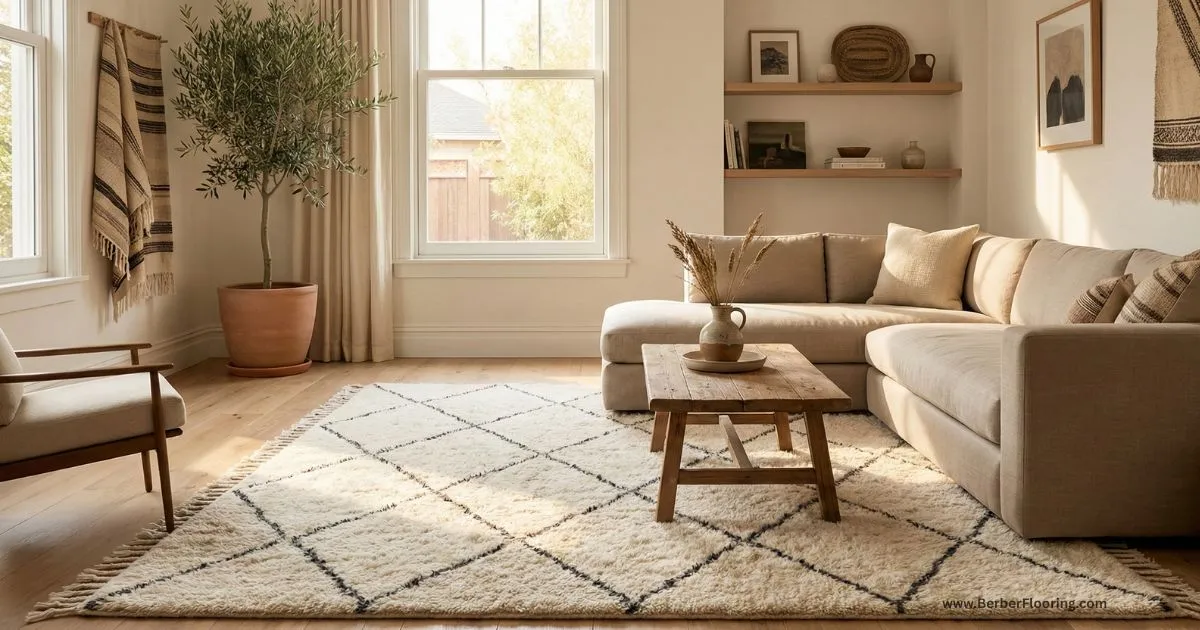
The most significant turning point in the global history of Berber rugs occurred during the Mid-Century Modern movement. Architects like Le Corbusier and designers like Ray and Charles Eames discovered that the minimalist, shaggy Beni Ourain rugs provided the perfect organic counterpoint to the “machine-age” furniture of the era.
- Le Corbusier’s Vision: He famously used Beni Ourain rugs in his “Villa Church” and other projects, stating that the rugs’ primitive geometry was the “true architecture of the floor.”
- The Eames Connection: Photos of the Eames House show a rotating collection of Moroccan rugs, which they valued for their tactile warmth and “un-designed” authenticity.
4. Regional Expressions: A Map of History
History in Morocco is regional. Each mountain range produced a different response to the environment.
| Region | Historical Style | Key Feature |
|---|---|---|
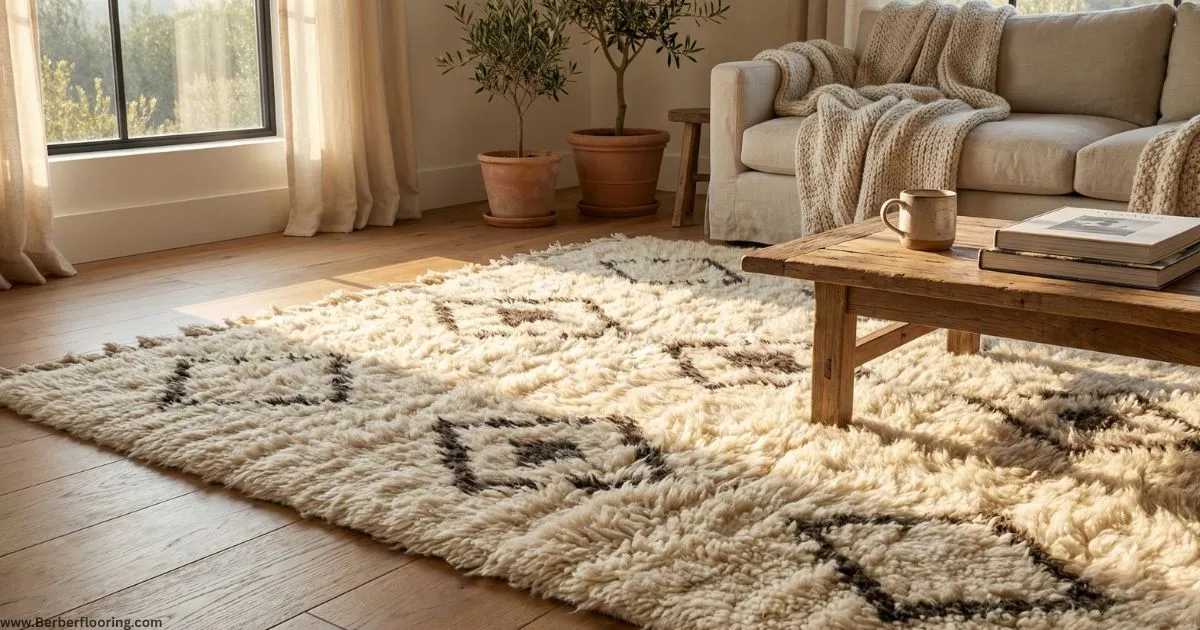
| Middle Atlas | Beni Ourain | Thick, insulating wool for high-altitude winters. |
| High Atlas | Ourika / Talsint | Vibrant, expressive colors using local vegetation. |
| Haouz Plains | Rehamna | Deep reds and complex, “shattered” geometric motifs. |
| Pre-Sahara | Vintage Flatweaves | Lightweight, portable textiles for nomadic life. |
5. Preserving the Legacy in the 21st Century
Today, the history of the Berber rug faces new challenges. Mass industrialization in the late 20th century led to a flood of synthetic “Berber carpets.” However, a 2026 resurgence in “Ancestral Sourcing” has revitalized traditional weaving cooperatives.
- Sustainable Future: Because hand-weaving requires zero electricity and uses carbon-sequestering natural wool, it is now being studied as a model for sustainable luxury production.
- Intellectual Property: There is a growing movement in Morocco to grant “Geographic Indicator” status to specific rug styles, ensuring that a “Beni Ourain” can only be called such if it is woven in its traditional tribal territory.
FAQ: History & Heritage
How old is the oldest known Berber rug?
While wool is biodegradable and rarely survives more than 150 years, the weaving techniques and Tifinagh symbols found in modern rugs have been documented in North African rock art and early medieval manuscripts dating back to the 7th century.
Why were they traditionally made by women?
In Amazigh culture, women were the weavers, poets, and storytellers. Weaving was a social activity and a way for women to record personal and tribal history during the long winter months in the mountains.
What is a 'Vintage' Berber rug vs. a 'New' one?
A 'Vintage' rug is typically at least 30-50 years old and shows signs of natural aging and tribal use. A 'New' rug is woven today using traditional methods. For a deep dive into the value of aged pieces, see our [Guide to Vintage Berber Rugs](https://berberflooring.com/rug-types/vintage/).
Conclusion The Moroccan Berber rug is a survivor. It has traveled from the cold tents of the Middle Atlas to the world’s most prestigious museums. By understanding its history, you aren’t just buying a piece of decor; you are participating in a 1,000-year-old conversation about art, survival, and human creativity.